I'm sending a novel pitch out to agents, and one responds with interest. This means it's time to send a full proposal: synopsis, character sketches, sample chapters, author bio.
Years ago, I forged ahead with confidence and zeal, believing I was hot stuff. I didn't need anyone to tell me how to revise or improve my writing. I was young and smart and perfect and error-free. Now, after a decade of rejection after rejection, I've realized the beauty of humble living. I've realized the danger of an independent spirit that--when left alone and unchecked--makes a person believe they are better and more important than they are.
This time (older, wiser, realistic), I send my chapters to neighbors who respond with the most insightful and clear revision suggestions. The Local Artist, for example, sees what I don't see: unclear sentences, confusing details, unrealistic scenes, clichés. Her commentary rids the prose of excess and turns each sentence towards its best position.
I want her to now edit my life. Living with flair means abandoning my independent spirit so others can suggest and revise. They see what I don't see.
________________________
It's hard to let others see your work and your life, offering it up for revision and commentary. Have you had good experiences when you allow others to "edit" you?

Showing posts with label writing. Show all posts
Showing posts with label writing. Show all posts
Sunday, December 11, 2011

Friday, November 25, 2011
How to Write a Great Holiday Letter
After years of trying to write good Christmas letters, I realize that my own letters fall into one of three categories.
1. Too Much Information
2. Too Much "We're Awesome"
3. Truly Inspirational and Insightful
Too Much Information means I'm telling readers what I ate at every Mexican restaurant on my trip. Too Much We're Awesome means I use the letter as a catalog of all my children's (and pets') accomplishments.
I want to inspire and teach, not brag and exhaust.
Truly Inspirational and Insightful Holiday Letters teach us something. They inspire us--and even make us laugh--with the insight we've gained this year. When these letters (I'm thinking of some of my favorite over the years) arrive, my husband literally sits down with a cup of coffee to enjoy the humor and insight that he knows the letter will offer.
With this goal in mind, we can eliminate any extraneous information that doesn't offer insight. With this goal in mind, we can ask ourselves if we've designed a paragraph intended to evoke jealousy or prove our worth. With this goal in mind, we can purify our motivation to love our reader.
If the sentence doesn't match these goals, chop it out.
As a devotional practice, I use the Holiday Letter task as a way to reflect on my year. What did I learn? How did our family change? What did we overcome? What wisdom can we offer now?
These holiday letters inspire. These holiday letters are worth sending. And sometimes a great holiday letter will matter more than the cute photo of my children in matching sweaters by the tree.
You can use the "Flair Checklist" below to help with your writing style. Enjoy! And here's a link to the Italian Mama's sample Holiday Letter.
(How to Write with Flair: Strong verbs, cool punctuation marks, varied sentence lengths and openings, some garnish, and appeals to your audience. Order the book here: https://www.createspace.com/3471782)
_______________________
What advice would you offer for writing great Holiday Letters?
1. Too Much Information
2. Too Much "We're Awesome"
3. Truly Inspirational and Insightful
Too Much Information means I'm telling readers what I ate at every Mexican restaurant on my trip. Too Much We're Awesome means I use the letter as a catalog of all my children's (and pets') accomplishments.
I want to inspire and teach, not brag and exhaust.
Truly Inspirational and Insightful Holiday Letters teach us something. They inspire us--and even make us laugh--with the insight we've gained this year. When these letters (I'm thinking of some of my favorite over the years) arrive, my husband literally sits down with a cup of coffee to enjoy the humor and insight that he knows the letter will offer.
With this goal in mind, we can eliminate any extraneous information that doesn't offer insight. With this goal in mind, we can ask ourselves if we've designed a paragraph intended to evoke jealousy or prove our worth. With this goal in mind, we can purify our motivation to love our reader.
If the sentence doesn't match these goals, chop it out.
As a devotional practice, I use the Holiday Letter task as a way to reflect on my year. What did I learn? How did our family change? What did we overcome? What wisdom can we offer now?
These holiday letters inspire. These holiday letters are worth sending. And sometimes a great holiday letter will matter more than the cute photo of my children in matching sweaters by the tree.
You can use the "Flair Checklist" below to help with your writing style. Enjoy! And here's a link to the Italian Mama's sample Holiday Letter.
(How to Write with Flair: Strong verbs, cool punctuation marks, varied sentence lengths and openings, some garnish, and appeals to your audience. Order the book here: https://www.createspace.com/3471782)
Flair Checklist
1. Do I use vivid verbs?
2. Are my verbs in their strongest form (cutting board test)?
3. Do I juggle some secret ingredients throughout my writing (semicolons, dashes, commas, parentheses, and colons)?
4. Do I “stir the pot” with varied sentence structures and lengths?
5. Have I embellished my writing with garnish in some form?
6. Have I analyzed my audience? Do I know them?
7. Do I attempt to build rapport with my readers?
8. Does my diction match my intent and my audience?
9. Have I shown my audience that I understand them and have listened to them?
10. Would my audience feel cared for by me? Do I put in some love?
11. Do I appeal to emotion in this writing (pathos)?
12. Do I seem trustworthy (ethos)?
13. Do I engage the reader’s reasoning skills (logos)?
14. Do I make use of good transition sentences?
15. Have I demonstrated the importance of my topic? Do I tell my readers why this writing matters?
16. Was I able to form an analogy to advance my point?
17. Did I enjoy the process of writing this? What can I do differently to celebrate the writing task?
18. Do I offer a unique contribution to the conversation surrounding my topic?
19. Do I avoid cliché in my writing?
20. Is this writing memorable?
_______________________
What advice would you offer for writing great Holiday Letters?
Thursday, November 24, 2011
Feast on the Empty
We're walking in the woods this Thanksgiving Day, and autumn has starved the whole landscape of color.
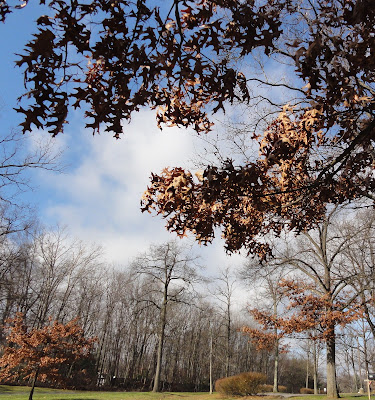
When I look up, I see tree branches stretched toward heaven like coral against a blue sea.
The branches tangle up in currents of blue and white
We're all down here, swimming in a great blue sea. I'm miniature against an enormous coral reef. I see it in my mind, and the whole story unfolds in color.
The emptiness invites the poetry.
When life seems stark, you get to make the beauty yourself. You feast on the empty.
_______________________
Happy Thanksgiving!

When I look up, I see tree branches stretched toward heaven like coral against a blue sea.
 |
| Tree Branches Like Coral |
 |
| Tangled in the Sky |
We're all down here, swimming in a great blue sea. I'm miniature against an enormous coral reef. I see it in my mind, and the whole story unfolds in color.
The emptiness invites the poetry.
When life seems stark, you get to make the beauty yourself. You feast on the empty.
_______________________
Happy Thanksgiving!
Monday, October 3, 2011
What to Tell Yourself When You're Nervous
As soon as you launch out into anything public, you might suddenly become very nervous.
When I speak, teach, blog, or lead, I've learned that my nervousness stems from a fear of shame--of rejection--that once removed, sets me free to be myself in front of a crowd.
When I wonder what others will think of me, I get nervous.
When I wonder whether or not I will do a good job, I get nervous.
When I wonder whether or not I should be doing this public thing, I get nervous.
So I try to stop wondering these things by (and I know this sounds crazy) learning to anticipate the worst that might happen. Rejection? Mockery? I've been there and survived (with flair). I remember that my public offerings represent gifts to the audience I serve. Others might reject the gift, but the point is I'm giving--not receiving--from the audience. I pray God enables it to not be about me. I also remember that public opportunities are acts of obedience to my calling. In this sense, I'm performing for a God who already approves, already accepts, and already delights in me. There's no earning my own way; there's nothing at stake.
Living with flair means going public.
_______________
Journal: Are you ready to be in public?
When I speak, teach, blog, or lead, I've learned that my nervousness stems from a fear of shame--of rejection--that once removed, sets me free to be myself in front of a crowd.
When I wonder what others will think of me, I get nervous.
When I wonder whether or not I will do a good job, I get nervous.
When I wonder whether or not I should be doing this public thing, I get nervous.
So I try to stop wondering these things by (and I know this sounds crazy) learning to anticipate the worst that might happen. Rejection? Mockery? I've been there and survived (with flair). I remember that my public offerings represent gifts to the audience I serve. Others might reject the gift, but the point is I'm giving--not receiving--from the audience. I pray God enables it to not be about me. I also remember that public opportunities are acts of obedience to my calling. In this sense, I'm performing for a God who already approves, already accepts, and already delights in me. There's no earning my own way; there's nothing at stake.
Living with flair means going public.
_______________
Journal: Are you ready to be in public?
Tuesday, September 27, 2011
Can You Make This Unfamiliar?
I'm teaching my students how to de-familiarize themselves from their own writing in order to find errors. It's a strange phenomenon of writing: when you write a paragraph and then reread it, it's as if the brain knows how it should read and somehow blinds us to mistakes.
We need to make the text unfamiliar again.
I invite them to read their paragraphs in reverse order; I encourage them to change the font; I have them read words on paper instead of on a screen; I challenge them to give the writing a 48 hour break. I knew a man in graduate school who placed a ruler under every line of text in order to detach it from its context. He could find errors every time.
All day, I remember the beauty and power of the unfamiliar. I remember why I need to detach from the old familiar contexts. In familiar settings, coping mechanisms, dysfunctional relational patterns, and spiritual blind spots set in. But remove me from my settings and get me away from the familiar? Suddenly I have clear focus. I can see all the junk. I think this explains the importance of weekend retreats, marriage date nights, travel opportunities, and simple changes in routine. This explains why I need to get on my knees, away from my life patterns, to listen to God.
We makes things unfamiliar in order to see again.
________________
Journal: How can we make our lives a little unfamiliar today?
We need to make the text unfamiliar again.
I invite them to read their paragraphs in reverse order; I encourage them to change the font; I have them read words on paper instead of on a screen; I challenge them to give the writing a 48 hour break. I knew a man in graduate school who placed a ruler under every line of text in order to detach it from its context. He could find errors every time.
All day, I remember the beauty and power of the unfamiliar. I remember why I need to detach from the old familiar contexts. In familiar settings, coping mechanisms, dysfunctional relational patterns, and spiritual blind spots set in. But remove me from my settings and get me away from the familiar? Suddenly I have clear focus. I can see all the junk. I think this explains the importance of weekend retreats, marriage date nights, travel opportunities, and simple changes in routine. This explains why I need to get on my knees, away from my life patterns, to listen to God.
We makes things unfamiliar in order to see again.
________________
Journal: How can we make our lives a little unfamiliar today?
Tuesday, September 20, 2011
Offering a Blank Page
Just now, my printer chokes and halts. An orange warning light flickers. A message alert flashes on my computer screen: No paper.
I find the stack of new paper, bend down to fill the printer, and suddenly realize something. Looking at that new blank page warns me somehow. It becomes a spiritual moment right here by the old printer.
I consider how only a blank page will produce a clear document.
I know this because I've accidentally put used paper in my printer that bore the marks of old essays, chapters from novels, or random printouts from various websites. When you try to print on paper that's already filled, the printer spits out gobbledygook.
You just can't read words overlying other words or paragraphs imprinted atop other paragraphs. (Gobbledygook really is a word. It means meaningless, unintelligible, nonsense language.)
Only a blank page will do. I realize I have a script for my life--words on the page I want--butI long for the willingness to hand God a blank page. Trying to merge my own narrative onto the one He's writing produces a kind of gobbledygook: stress, meaninglessness, and chaos. If only I might offer the blank page and let another Writer compose!
_______________________
Journal: Offering up a blank page seems very freeing, but also terrifying. What script or story line do I need to clear from my life?
I find the stack of new paper, bend down to fill the printer, and suddenly realize something. Looking at that new blank page warns me somehow. It becomes a spiritual moment right here by the old printer.
I consider how only a blank page will produce a clear document.
I know this because I've accidentally put used paper in my printer that bore the marks of old essays, chapters from novels, or random printouts from various websites. When you try to print on paper that's already filled, the printer spits out gobbledygook.
You just can't read words overlying other words or paragraphs imprinted atop other paragraphs. (Gobbledygook really is a word. It means meaningless, unintelligible, nonsense language.)
Only a blank page will do. I realize I have a script for my life--words on the page I want--butI long for the willingness to hand God a blank page. Trying to merge my own narrative onto the one He's writing produces a kind of gobbledygook: stress, meaninglessness, and chaos. If only I might offer the blank page and let another Writer compose!
_______________________
Journal: Offering up a blank page seems very freeing, but also terrifying. What script or story line do I need to clear from my life?
Wednesday, August 31, 2011
Sending Your Voice Into the World
 On the walk home from school, an extraordinary sight greets us. A beautiful hot air balloon hovers in the morning sky. (My husband's phone snapped this photo, but you can't tell how vibrant the balloon is. Just imagine!)
I race into the middle of the street, spread my arms wide, and wave at them. I'm jumping in the air, and I'm calling out, "Hello up there! Hello up there!" I realize I'm a colossal embarrassment. I realize this doesn't make any sense.
Someone on the ground says, "They won't be able to hear you."
But still, I shout and wave. Then, I hear an answer.
"Hello!" They hear me! They answer. They wave and call down from inside the basket. I see a tiny arm waving to me. I hear the voice and smile. Our voices travel across this huge distance.
All morning, I realize how ridiculous of a notion it was to raise my voice and expect an answer. But my voice was heard, and an answer did come.
You just never know how far your voice will travel. You never know who might hear--from no matter how far away or in whatever unusual circumstance--the thing you have to say.
Living with flair means you go ahead and send your voice out into the world. You have no idea who can hear it and answer you.
_____________________
Journal: Go ahead and say what you want to say today.
Sunday, August 14, 2011
What a Change of Background Can Do
I realize today that I love experimenting with background. The word technically means the "scenery behind the main object of contemplation, especially when perceived as a framework for it." We distinguish objects and circumstances--understanding them properly--because we measure them against their background.
Live with Flair is my background. A different background changes how we understand and see.
I gaze into a deep, clear lake, and I have to capture the apple tree against that beauty. What's behind the object--the setting--fascinates me. It frames and contextualizes. It tells a story.

Just as in photography and writing, I think carefully about what background I'm choosing to view my own life against. What subtext, what ideologies, what memories, what conversations? Do these frame my life the way I want--in beauty, hope, and joy--or do they obscure, depress, and oppress?
I'm starting to wonder if I can identify sources of unhappiness and despair by asking folks what singular background they view themselves against.
I chose a different frame the day I started blogging. I decided to set my life against the background that I've been "blessed with every spiritual blessing in Christ" and that nothing happens to me today that God doesn't use to "work out everything in conformity to the purpose of his will."
It's been 510 days of seeing life differently. God is good. All the time.
________________________
Journal: Do I need to change my background today?
Live with Flair is my background. A different background changes how we understand and see.
I gaze into a deep, clear lake, and I have to capture the apple tree against that beauty. What's behind the object--the setting--fascinates me. It frames and contextualizes. It tells a story.

Just as in photography and writing, I think carefully about what background I'm choosing to view my own life against. What subtext, what ideologies, what memories, what conversations? Do these frame my life the way I want--in beauty, hope, and joy--or do they obscure, depress, and oppress?
I'm starting to wonder if I can identify sources of unhappiness and despair by asking folks what singular background they view themselves against.
I chose a different frame the day I started blogging. I decided to set my life against the background that I've been "blessed with every spiritual blessing in Christ" and that nothing happens to me today that God doesn't use to "work out everything in conformity to the purpose of his will."
It's been 510 days of seeing life differently. God is good. All the time.
________________________
Journal: Do I need to change my background today?

Saturday, August 6, 2011
Doing What You Love
Today I remember a conversation I had with my husband years ago. We were talking about careers and our future. We asked this question: "What makes you feel most alive and most like yourself?" His answer matched exactly with what he was already doing with his life.
Mine didn't, but I was getting there. I felt most alive and most me when I was teaching and writing. So I reasoned that God made me for these things. In His goodness and creativity, perhaps God made it so that when we are doing what we are supposed to be doing, it will feel like we're fully alive, energized, and truly ourselves.
I'm starting to believe that when we find that thing we were made for, it won't feel like drudgery. Maybe it won't feel like work.
Psychologist Greg Hocott was once asked how he could manage his difficult counseling practice. He writes, "I think the answer is found in doing what God created us to do. We are all endowed with specific talents and gifts, and as long as we live within them, 'work' seems less difficult."
Maybe this explains why blogging never feels like work. Maybe this explains why I can't wait for the new semester to start. I'll tell my students that I love teaching and writing so much that I would do it for free. That's a good thing, I'll tell them, because I practically am doing it for free. Nobody teaches for the money!
Living with flair means finding ways to do what we love. It means being brave enough to pursue those paths.
______________________
Journal: Do you love your work so much you would do it for free?
Mine didn't, but I was getting there. I felt most alive and most me when I was teaching and writing. So I reasoned that God made me for these things. In His goodness and creativity, perhaps God made it so that when we are doing what we are supposed to be doing, it will feel like we're fully alive, energized, and truly ourselves.
I'm starting to believe that when we find that thing we were made for, it won't feel like drudgery. Maybe it won't feel like work.
Psychologist Greg Hocott was once asked how he could manage his difficult counseling practice. He writes, "I think the answer is found in doing what God created us to do. We are all endowed with specific talents and gifts, and as long as we live within them, 'work' seems less difficult."
Maybe this explains why blogging never feels like work. Maybe this explains why I can't wait for the new semester to start. I'll tell my students that I love teaching and writing so much that I would do it for free. That's a good thing, I'll tell them, because I practically am doing it for free. Nobody teaches for the money!
Living with flair means finding ways to do what we love. It means being brave enough to pursue those paths.
______________________
Journal: Do you love your work so much you would do it for free?
Saturday, July 16, 2011
Who But You?
As I prepare my writing seminar, I receive emails and comments from folks asking sadly, "What do I have to write that's worth reading? Why would anyone read what I have to write?"
In Mary Pipher's book, Writing to Change the World, she entitles a chapter, "What You Alone Can Say." She claims, "You have something to say that no one else can say. Your history, your unique sensibilities, your sense of place and your language bestow upon you a singular authority. Who but you can describe the hollyhocks in your grandmother's backyard or the creek outside of town that you fished as a child. . . ?"
Who but you?
______________
Journal: What will you write that you alone can say?
In Mary Pipher's book, Writing to Change the World, she entitles a chapter, "What You Alone Can Say." She claims, "You have something to say that no one else can say. Your history, your unique sensibilities, your sense of place and your language bestow upon you a singular authority. Who but you can describe the hollyhocks in your grandmother's backyard or the creek outside of town that you fished as a child. . . ?"
Who but you?
______________
Journal: What will you write that you alone can say?
Saturday, July 2, 2011
Why I'm Now Using Twitter
Last night, I tell my friend that I'm definitely not interested in using twitter. "Why would anyone care where I am or what I am doing?" Besides, I don't really know how to twitter.
"You're thinking about twitter all wrong," he says. "Twitter is about influence. You don't tell people that you're eating a hamburger right now. You tell people that you're eating the best hamburger, and you give information about where and how they can eat the best hamburger as well. You're influencing others with good information."
But what would I influence people about? I blog about beautiful things--just to share them with the world--but how could I use twitter, too?
I woke up wondering about this. Then my youngest daughter asked me to teach her how to know whether a peach is perfectly ripe. I had been feeling horribly inadequate as a mother all week, and then all of a sudden I didn't. Motherhood wasn't about big moments or spectacular feats of patient nurturing. It was, in part, about very small moments of instruction.
We felt peaches together in the kitchen.
The peach instruction opened a new world of confidence in mothering. What else could I impart today?
So I twittered about the peach. In 140 characters, I hoped to influence other mothers who felt bad about themselves today.
Living with flair means influencing others when you learn something.
________________________
Journal: Can I influence others about something today?
"You're thinking about twitter all wrong," he says. "Twitter is about influence. You don't tell people that you're eating a hamburger right now. You tell people that you're eating the best hamburger, and you give information about where and how they can eat the best hamburger as well. You're influencing others with good information."
But what would I influence people about? I blog about beautiful things--just to share them with the world--but how could I use twitter, too?
I woke up wondering about this. Then my youngest daughter asked me to teach her how to know whether a peach is perfectly ripe. I had been feeling horribly inadequate as a mother all week, and then all of a sudden I didn't. Motherhood wasn't about big moments or spectacular feats of patient nurturing. It was, in part, about very small moments of instruction.
We felt peaches together in the kitchen.
The peach instruction opened a new world of confidence in mothering. What else could I impart today?
So I twittered about the peach. In 140 characters, I hoped to influence other mothers who felt bad about themselves today.
Living with flair means influencing others when you learn something.
________________________
Journal: Can I influence others about something today?
Thursday, June 30, 2011
Lingering Questions
I'm studying the art of telling a good story. It's helping me live with flair.
Today, I read that every great novel needs mystery and conflict. Otherwise, the reader won't turn the page. As readers, we love and expect a good mystery and a grand conflict. We want each chapter--maybe even each page--to have a lingering question.
But what about in real life?
I think that every great life needs mystery and conflict. There's something beautiful and full of flair about the unresolved. There's joy in the lingering questions. Is it possible that mystery and conflict are written into our own stories on purpose to drive us onward? All morning, I think about what it means to trust the Author within the mystery and conflict (internal and external) of my own life's journey. Do these lingering life questions have a purpose?
Mystery and conflict provide great motivation to continue on with hope and expectancy. I'm actually thanking God for writing these elements into my own story.
______________________
Journal: What are my great life mysteries? What internal and external conflicts do I need to resolve in my story?
Today, I read that every great novel needs mystery and conflict. Otherwise, the reader won't turn the page. As readers, we love and expect a good mystery and a grand conflict. We want each chapter--maybe even each page--to have a lingering question.
But what about in real life?
I think that every great life needs mystery and conflict. There's something beautiful and full of flair about the unresolved. There's joy in the lingering questions. Is it possible that mystery and conflict are written into our own stories on purpose to drive us onward? All morning, I think about what it means to trust the Author within the mystery and conflict (internal and external) of my own life's journey. Do these lingering life questions have a purpose?
Mystery and conflict provide great motivation to continue on with hope and expectancy. I'm actually thanking God for writing these elements into my own story.
______________________
Journal: What are my great life mysteries? What internal and external conflicts do I need to resolve in my story?
Tuesday, June 28, 2011
Wanting Your Story Told
I'm ordering a smoothie (raspberry and peach), and the young woman making it asks me what I'm doing for the rest of my day.
"I'm writing," I tell her. "I have this idea for a novel, and I want to start it today."
She leans over the counter top and looks to her left and then her right. "Do you have ten minutes?"
"Yes."
"I have a good story for you. You'll never believe it, but it's true. It's my life. Maybe afterwards you will write my story."
I sit there drinking my smoothie while she recounts her childhood in Venezuela, her failed marriage at just eighteen years old, her dreams to become an artist, and what she's learning in therapy.
"I tend to become everybody's mother," she says. "I'm not doing that anymore."
I thank her for her story, and she adds, "You can use all of this in your novel. That's how it works, right? You meet someone and they inspire a great story. But I want to look good in it, you know. Not like a crazy woman or anything."
I tell her I'll return for another smoothie on another day. Maybe I will write down her story. I'd like to know more about this Venezuelan young woman, wouldn't you?
________________
Journal: Who needs to tell you their story? Do you have a life story that people might not believe?
"I'm writing," I tell her. "I have this idea for a novel, and I want to start it today."
She leans over the counter top and looks to her left and then her right. "Do you have ten minutes?"
"Yes."
"I have a good story for you. You'll never believe it, but it's true. It's my life. Maybe afterwards you will write my story."
I sit there drinking my smoothie while she recounts her childhood in Venezuela, her failed marriage at just eighteen years old, her dreams to become an artist, and what she's learning in therapy.
"I tend to become everybody's mother," she says. "I'm not doing that anymore."
I thank her for her story, and she adds, "You can use all of this in your novel. That's how it works, right? You meet someone and they inspire a great story. But I want to look good in it, you know. Not like a crazy woman or anything."
I tell her I'll return for another smoothie on another day. Maybe I will write down her story. I'd like to know more about this Venezuelan young woman, wouldn't you?
________________
Journal: Who needs to tell you their story? Do you have a life story that people might not believe?
Thursday, May 5, 2011
What My Daughter Brought to Show and Tell
This morning, my daughter puts a copy of How to Write with Flair in her backpack. It's her show-and-tell day.
I want to cry.
I think that motherhood is all about celebrating children, but sometimes, they celebrate us.
"I'm proud of you, Mom."
I'm going to go cry now.
______________
Journal: I want to do things that make my children proud. I haven't thought of it this way before. Am I living a life that my children will continue to celebrate?
I want to cry.
I think that motherhood is all about celebrating children, but sometimes, they celebrate us.
"I'm proud of you, Mom."
I'm going to go cry now.
______________
Journal: I want to do things that make my children proud. I haven't thought of it this way before. Am I living a life that my children will continue to celebrate?
Thursday, April 28, 2011
Why (and How) I Wrote a Writing Book
 I remember the exact moment when a student called out from the back of the room and said, "Dr. H., I just want to learn how to write! I'm tired of all these grammar rules and fancy rhetorical terms!"
He wanted to write. And the expensive grammar books weren't helping him. I stood at the chalkboard, and I told him that every writer needs just five lessons. I talked about the power of strong verbs and the need for sentence variation through punctuation marks like the semicolon and parentheses. I talked about how to create rhythm by changing up the length of our sentences. Then I talked about how to be clever using wordplay like repetition and puns. Finally, I talked about how to build rapport with your readers.
That was it. Class over. I walked to my car and thought, "Somebody should really write a book about how to write in 5 easy lessons."
Remember my problem with saying, "Somebody should really. . . "? (I was that somebody.)
So I did it. Over my winter break, I wrote out the lessons. I took my little writing handbook to a print shop, and I assigned it the next semester. Students emailed me to tell me that their fraternity brothers or their parents or their cousins wanted copies. Others would report that my book "changed everything" and now they had confidence in writing. I found notes in my mailbox from students claiming that my verb lessons have made them amazing writers in all their other classes.
Maybe my life calling has something to do with verbs. I'm OK with how nerdy that sounds.
With so many positive evaluations, I decided to publish How to Write with Flair and sell it as a real book. I didn't know how, but I knew I was supposed to.
Within a few weeks, some strange things started happening. A neighbor told me about createspace.com, and I learned how to put a manuscript together. Then, I discovered that the neighbor to my right was an editor the same week I learned my neighbor to my left was a professional typesetter. They wanted to help me publish my book! But I needed a cover design and an author photo. No problem. I found a photographer mom at gymnastics class (of all places!), and I remembered a dear friend who had a knack for graphic design. My whole community was helping me and encouraging me!
Yesterday, I started to sell my first book. Who knows what will happen? All I know is that living with flair means you move forward with crazy ideas because you think they might help someone.
PS: You can find How to Write with Flair here: https://www.createspace.com/3471782
____________________________
Journal: Do you have an idea that you need to move on?
Tuesday, April 26, 2011
The Best Day of Your Life
I wrote that title before the day even happened. Did you choose to read this post because of the title? More folks might read this if it said, "The Worst Day of Your Life," because studies report that we're attracted to pain and negativity.
I'm teaching the power of a great title in my writing classes this week. The title makes all the difference. It determines whether I engage with the writing, how I engage with the writing, and why I'll keep reading. The title gives a shape and a focus for a text, and that got me thinking about writing and living with flair.
What if I titled my day? What if I chose a title this morning that made me engage differently? What if I shaped and focused this day by a title? Here are some possible titles for a day:
The Day Everything Changed
The Day I Finally Did It
The Day I Became the Person I'm Supposed to Be
The Day I Surrendered Everything
The Day I Found Beauty in Pain
The Day I Rose Above My Circumstances
The Day I Laughed So Hard I Cried
The Day I Did the Thing I Feared the Most
The Day I Chose Happiness
The Day I Discovered How to Really Love Someone Else
Living with flair means I choose a title for my day. And then I move forward and live it.
__________________
Journal: How did you title today?
I'm teaching the power of a great title in my writing classes this week. The title makes all the difference. It determines whether I engage with the writing, how I engage with the writing, and why I'll keep reading. The title gives a shape and a focus for a text, and that got me thinking about writing and living with flair.
What if I titled my day? What if I chose a title this morning that made me engage differently? What if I shaped and focused this day by a title? Here are some possible titles for a day:
The Day Everything Changed
The Day I Finally Did It
The Day I Became the Person I'm Supposed to Be
The Day I Surrendered Everything
The Day I Found Beauty in Pain
The Day I Rose Above My Circumstances
The Day I Laughed So Hard I Cried
The Day I Did the Thing I Feared the Most
The Day I Chose Happiness
The Day I Discovered How to Really Love Someone Else
Living with flair means I choose a title for my day. And then I move forward and live it.
__________________
Journal: How did you title today?
Friday, March 11, 2011
On Watching the News of the Tsunami in Japan
As I grade papers today, I want to ignore the background buzz and flicker of a news channel showing footage of the earthquake and tsunami in Japan. I watch someone's home burst into flames and float away. I watch a cargo ship turn over on its side as simply as a man changing positions in his sleep. From an aerial vantage point, it seems like someone has poured buckets of black paint over the farmland. I want to turn away from this news and this reality.
I see a minivan turn circles in the water like a silver leaf.
Not until the voice behind the footage reminds me that I'm watching a wall of water moving at 500 mph do I suddenly imagine the noise, the wind, and the smell of it. I look at that minivan and think of a family going about their day. It's not a leaf. It's a family in a vehicle.
Just this morning, my youngest daughter hears the radio announce that an earthquake has hit Japan. Tears well up and she says, "Mama, Aki is in Japan."
We leave for school and go about the day with that tsunami in the background of our minds. I force it to the forefront--choosing to remember, choosing to pray. It's too easy to forget. It's too easy not to hear that background story of a country in crisis.
I force myself to write about it. But I don't want to think about it. It's not happening here. It's over there.
I go back to grading. A student has written an analysis of W.H. Auden's poem, "Musee des Beaux Arts." Auden writes about how, in the face of widespread human suffering, "everything turns away / Quite leisurely from the disaster" because we have "somewhere to get to."
I don't want to turn away. I'm in this, and for me, being in this means I write. That keeps it in the foreground. That's keeps me from turning away today.
I write and pray for Japan today, and that's how I'm choosing to live with flair.
__________________________
Journal: How can I stay "in this" today? Is it important to do this?
I see a minivan turn circles in the water like a silver leaf.
Not until the voice behind the footage reminds me that I'm watching a wall of water moving at 500 mph do I suddenly imagine the noise, the wind, and the smell of it. I look at that minivan and think of a family going about their day. It's not a leaf. It's a family in a vehicle.
Just this morning, my youngest daughter hears the radio announce that an earthquake has hit Japan. Tears well up and she says, "Mama, Aki is in Japan."
We leave for school and go about the day with that tsunami in the background of our minds. I force it to the forefront--choosing to remember, choosing to pray. It's too easy to forget. It's too easy not to hear that background story of a country in crisis.
I force myself to write about it. But I don't want to think about it. It's not happening here. It's over there.
I go back to grading. A student has written an analysis of W.H. Auden's poem, "Musee des Beaux Arts." Auden writes about how, in the face of widespread human suffering, "everything turns away / Quite leisurely from the disaster" because we have "somewhere to get to."
I don't want to turn away. I'm in this, and for me, being in this means I write. That keeps it in the foreground. That's keeps me from turning away today.
I write and pray for Japan today, and that's how I'm choosing to live with flair.
__________________________
Journal: How can I stay "in this" today? Is it important to do this?
Friday, December 10, 2010
Write Like A Jellyfish
Today, one of my favorite on-line communities, The High Calling, features my flair for the day. Enjoy the beginning of the post here, and please read more over at a great website that helps us deeply consider life, work, and faith.
It's the last day of the semester.
I smooth out a new page, unzip my red pencil case, and attempt--along with these college students--the art of writing with flair. The rain outside transforms to ice. We hear its tiny fingers pelt the window begging for entrance into this warm space.
With my own pencil poised, I ask the question again: "How do we get our own voices--the authentic ones deep within our hearts shared by no other living soul--onto the page?" Lately, I've made my writing lessons all about voice. Early in my writing teacher career, I learned that high school and college writing instruction attempts to remove voice from writing. Make it academic. Make it sophisticated. My students always, always ask me (in a timid, near whisper) if it's OK for them to use the word, "I."
It's like they're trespassing, violating some rule. If they put the voice back into their writing, somebody will cross out the sentence and send them back to their desk to imitate some other scholar's prose. The subtext: Don't sound like you. Sound like us.
But there's something that only they can say, in only their way, in their own voice.
What's a voice in writing? How do I get to it? Read on. . .
It's the last day of the semester.
I smooth out a new page, unzip my red pencil case, and attempt--along with these college students--the art of writing with flair. The rain outside transforms to ice. We hear its tiny fingers pelt the window begging for entrance into this warm space.
With my own pencil poised, I ask the question again: "How do we get our own voices--the authentic ones deep within our hearts shared by no other living soul--onto the page?" Lately, I've made my writing lessons all about voice. Early in my writing teacher career, I learned that high school and college writing instruction attempts to remove voice from writing. Make it academic. Make it sophisticated. My students always, always ask me (in a timid, near whisper) if it's OK for them to use the word, "I."
It's like they're trespassing, violating some rule. If they put the voice back into their writing, somebody will cross out the sentence and send them back to their desk to imitate some other scholar's prose. The subtext: Don't sound like you. Sound like us.
But there's something that only they can say, in only their way, in their own voice.
What's a voice in writing? How do I get to it? Read on. . .
Friday, December 3, 2010
Will Technology Destroy My Teaching?
This morning my daughter announces that her class is going on a field trip to the University Astronomy Lab.
Her personal favorite planet is Jupiter.
All day, I've been thinking about the wonder she'll feel. These planetarium shows, according to the website, "feature spectacular astronomical images from the surface of Mars, to dusty nebulae, to dazzling galaxies, rendered in three dimensions with the aid of special eyeglasses and projection screens."
This kind of technology might just provide a sublime experience for these children. They might go on to study astrophysics, probing deeper into the mysteries of the universe.
I wish I were there with her.
But I had my own experience with technology and education today. I received my classroom assignment for next semester, so on my way back to the parking lot, I casually pop into my future classrooms. One of them hides deep within an ancient campus building. The tiny room has 25 chairs and desks and a long table up front (for me). I'm not sure I even have a chalkboard to use in that room. These are the rooms instructors beg to get switched. They shed tears over these assignments and bribe administrative assistants to send them to any other classroom.
But I love rooms like that. I request the simplest classroom.
The second classroom resides in a building I haven't visited yet--the Business School. I walk in, and I'm immediately transported to another universe. A ticker on the wall brags out the stock market numbers. Flat screen TV's broadcast major network news. Coffee shops send out an aroma that, in this environment, makes me feel rushed and nervous. Everybody's in suits, and the click of high heels on the floor breeds a strange insecurity in me.
I find my classroom.
It's spectacular, dazzling. Each wall has a projection screen, and I count no less than 7 white boards that light up for my notes. My podium up front features more buttons than I could ever figure out what to do with. It has a microphone. If I touch this one button, the lights dim and a huge screen descends behind me.
Maybe another button ushers in my avatar who teaches for me while I go get a latte.
The students' seats swivel, and I'm not sure, but I wonder if each desk has its own laptop built in.
I turn a circle in this future classroom, and then I immediately think: "This is so . . . distracting!"
What will I do with so much technology? What could it inspire in folks trying to learn to use strong verbs and varied sentence structure? Am I now putting on a show with lights and sounds? At what point does the technology distract rather than enrich?
I've posed the question to my technology-inundated students. Shall I change my course? One man leaned back (in his old desk) and said, "Don't do it. Don't use the technology. People want to talk about their ideas together in class. That's what they really want."
But is there something I'm missing?
Living with flair means I figure out how to use technology in ways that enrich and offer sublime experiences. Because it can. I just don't know how--as a writing teacher--it will.
Do you know?
Her personal favorite planet is Jupiter.
All day, I've been thinking about the wonder she'll feel. These planetarium shows, according to the website, "feature spectacular astronomical images from the surface of Mars, to dusty nebulae, to dazzling galaxies, rendered in three dimensions with the aid of special eyeglasses and projection screens."
This kind of technology might just provide a sublime experience for these children. They might go on to study astrophysics, probing deeper into the mysteries of the universe.
I wish I were there with her.
But I had my own experience with technology and education today. I received my classroom assignment for next semester, so on my way back to the parking lot, I casually pop into my future classrooms. One of them hides deep within an ancient campus building. The tiny room has 25 chairs and desks and a long table up front (for me). I'm not sure I even have a chalkboard to use in that room. These are the rooms instructors beg to get switched. They shed tears over these assignments and bribe administrative assistants to send them to any other classroom.
But I love rooms like that. I request the simplest classroom.
The second classroom resides in a building I haven't visited yet--the Business School. I walk in, and I'm immediately transported to another universe. A ticker on the wall brags out the stock market numbers. Flat screen TV's broadcast major network news. Coffee shops send out an aroma that, in this environment, makes me feel rushed and nervous. Everybody's in suits, and the click of high heels on the floor breeds a strange insecurity in me.
I find my classroom.
It's spectacular, dazzling. Each wall has a projection screen, and I count no less than 7 white boards that light up for my notes. My podium up front features more buttons than I could ever figure out what to do with. It has a microphone. If I touch this one button, the lights dim and a huge screen descends behind me.
Maybe another button ushers in my avatar who teaches for me while I go get a latte.
The students' seats swivel, and I'm not sure, but I wonder if each desk has its own laptop built in.
I turn a circle in this future classroom, and then I immediately think: "This is so . . . distracting!"
What will I do with so much technology? What could it inspire in folks trying to learn to use strong verbs and varied sentence structure? Am I now putting on a show with lights and sounds? At what point does the technology distract rather than enrich?
I've posed the question to my technology-inundated students. Shall I change my course? One man leaned back (in his old desk) and said, "Don't do it. Don't use the technology. People want to talk about their ideas together in class. That's what they really want."
But is there something I'm missing?
Living with flair means I figure out how to use technology in ways that enrich and offer sublime experiences. Because it can. I just don't know how--as a writing teacher--it will.
Do you know?
Monday, November 15, 2010
The Detail that Changes Everything
In class today, we read the description of the town of Maycomb in Harper Lee's To Kill a Mockingbird. As we imagine that beautiful Southern drawl, we hear how "ladies bathed before noon, after their three-o'clock naps, and by nightfall were like soft teacakes with frostings of sweat and sweet talcum."
That one detail comparing ladies to teacakes sets a mood for this little town. It's a comparison worth making.
The ladies like soft teacakes seem out of place. It's a tiny detail, amid the "red slop" of rainy streets and "bony mules" that flick flies away. There's even a dog suffering in the background. I don't want to live in a town like this.
But then, the writer introduces the lovely and delicate and transforms sweat to frosting and talcum. Already, I know something marvelous will happen in the mind of this narrator.
She's going to reconstruct a new reality for me.
As we work on our own personal memoir settings, we think deeply about tiny details that change how we understand our pasts. We are the characters, looking back over our lifetimes, and weaving threads of meaning into our experiences. Was there a detail that I couldn't see until this moment that offers a new reality? Is there a truth I might apply that I only see now? Back then, I only felt the heat and slop. But now?
Can I notice something different--one detail--that might turn sweat to frosting?
That one detail comparing ladies to teacakes sets a mood for this little town. It's a comparison worth making.
The ladies like soft teacakes seem out of place. It's a tiny detail, amid the "red slop" of rainy streets and "bony mules" that flick flies away. There's even a dog suffering in the background. I don't want to live in a town like this.
But then, the writer introduces the lovely and delicate and transforms sweat to frosting and talcum. Already, I know something marvelous will happen in the mind of this narrator.
She's going to reconstruct a new reality for me.
As we work on our own personal memoir settings, we think deeply about tiny details that change how we understand our pasts. We are the characters, looking back over our lifetimes, and weaving threads of meaning into our experiences. Was there a detail that I couldn't see until this moment that offers a new reality? Is there a truth I might apply that I only see now? Back then, I only felt the heat and slop. But now?
Can I notice something different--one detail--that might turn sweat to frosting?
Subscribe to:
Comments (Atom)